
Imagine you’re preparing to move a meaningful portion of your digital savings to a private wallet. You live in the U.S., you care about plausible deniability and avoiding leaks that map your transactions to your home IP, and you also want to hold Bitcoin, Litecoin and Monero without juggling two dozen apps. Which features actually matter, and where do trade-offs hide behind friendly buttons?
This article walks through a concrete, decision-focused case: a privacy-minded U.S. user who needs multi-currency custody, strong network anonymity, and hardware-grade protection for keys. I’ll show how the mechanics of a privacy-first wallet shape security outcomes, where Cake Wallet’s feature set mitigates real risks, and where operational discipline — not a single product — determines whether privacy holds in practice.
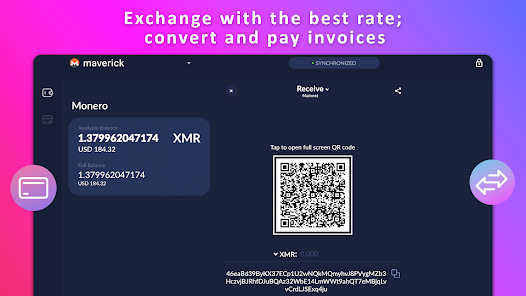
Case: a U.S. user preparing a multi-asset, privacy-preserving migration
Our user — call her Ana — wants three things: retain full control of private keys; transact Monero with minimal leakage; and move Bitcoin and Litecoin funds using privacy-enhancing primitives. She also wants the convenience of in-app swaps and occasional use of a hardware wallet. This scenario forces us to weigh four attack surfaces: network-level deanonymization (IP and metadata), key compromise (device or backup leakage), transaction graph linking across coins, and supply-chain or software compromise.
Mechanically, the wallet features that address those surfaces are distinct. Network anonymity is mitigated by Tor-only mode and I2P support plus the ability to choose your node; key compromise is reduced by device-level encryption (Secure Enclave/TPM) and by non-custodial key handling; transaction-linking can be reduced by coin-specific privacy layers (Monero subaddresses, Litecoin MWEB, Bitcoin PayJoin v2), and supply-chain risk is handled with open-source code and hardware wallet integration. Each of those mitigations alters risk — none eliminates it.
How the mechanisms work, and why each matters
Network privacy: Tor-only mode and I2P proxy support change where metadata lives. When the wallet routes traffic through Tor or I2P, your IP no longer accompanies wallet queries to remote nodes or relayers, reducing the single biggest practical risk of on-chain transactions becoming trivially tied to a physical location. But Tor is not a panacea: exit node timing, browser-level leaks, and misconfigured node settings can reintroduce linkability. The ability to connect to custom user-selected nodes is an important complement: running or selecting your node reduces reliance on third-party endpoints that might log connection metadata.
Device-level key protection: Storing wallet secrets in a hardware-backed root (Secure Enclave on iOS, TPM on Android) confines the private key material to a protected zone. This reduces the risk that malware or a compromised OS will exfiltrate keys. Still, hardware-backed storage does not substitute for operational best practices: weak PINs, social engineering, and backups left in unencrypted cloud storage remain real failure modes.
Coin-level privacy primitives: Monero uses ring signatures, stealth addresses and subaddresses; the wallet keeps the private view key on-device and supports background sync plus subaddresses so payments can be routed to unique addresses without revealing a reuse pattern. Litecoin’s MWEB provides an opt-in confidential transaction layer; enabling it changes how UTXOs are represented and helps hide amounts. Bitcoin privacy here is tactical: Silent Payments and PayJoin v2 aim to break simple on-chain linking and decouple inputs and outputs, while explicit UTXO coin control and batching reduce unnecessary dust and linkage. Each tool is useful, but effectiveness depends on correct use and ecosystem participation: PayJoin needs counterparties that support it; MWEB requires activation and compatible counterparties; Monero privacy is strong but still subject to timing and network metadata risks.
Trade-offs, limits and an often-missed boundary condition
Open-source, non-custodial design: Open code and client-side key custody are powerful because they shift trust from operators to protocols and your own operational security. However, openness also invites careful review; most users won’t audit code themselves. The practical boundary condition is this: non-custodial is only as secure as your device and recovery process. A hardware wallet integration helps — linking to Ledger or an air-gapped Cupcake device isolates signing — but you still need safe seed backup practices.
Cross-chain swaps and NEAR Intents: The wallet’s decentralized routing mechanism (NEAR Intents) finds competitive rates among market makers without centralized order books. That reduces counterparty risk, but it adds complexity: swap routing may reveal timing and volume metadata to market makers involved in the route. In other words, decentralized routing reduces central points of failure but introduces distributed metadata surfaces you should understand.
Zcash migration limitation: A concrete, operational example of a boundary condition: if you hold ZEC in a Zashi wallet, seed incompatibility means you cannot simply import that seed into Cake Wallet — you must create a new Cake ZEC wallet and manually transfer funds. This is the kind of friction that matters for users moving between ecosystems; it’s an explicit limitation to plan for, especially if you’re migrating sizable holdings.
Decision framework: a simple heuristic for choosing and configuring a privacy-first multi-currency wallet
Use this three-step heuristic when evaluating options:
1) Threat-first alignment: Identify your primary adversary (script kiddies, targeted law enforcement, ISP metadata collection) and prioritize mitigations that address that threat. If you worry about ISP-level correlation, prioritize Tor/I2P and custom nodes. If physical device compromise worries you more, prioritize hardware-wallet usage and air-gapped key generation.
For more information, visit monero wallet.
2) Coin-specific hygiene: For each asset, follow the best available privacy path: Monero — use subaddresses and keep view keys local; Bitcoin — enable PayJoin where possible, use UTXO control, avoid address reuse; Litecoin — consider MWEB for privacy-sensitive transfers. Treat each coin’s primitives as tools with activation and counterparty dependency.
3) Operational discipline: Seed backups must be offline, irreversibly separated from device IP traces, and stored using a tested recovery procedure. Test your hardware wallet setup and restore process on a small amount before moving large sums. Accept small friction for meaningful privacy gains — for example, run a local node or use Tor even though setup is more involved.
Where systems still break — and how to recognize it
Privacy failures are often not technical bugs but operational leaks. Common failure modes include: restoring from a compromised seed phrase copy stored in cloud services; using an exchange address that performs custodial sweeping; failing to enable mandatory shielding settings (relevant for Zcash) and thereby leaking funds to transparent pools; or performing observable swaps through market makers without obfuscation. Recognizing failure involves looking for metadata leakage, not just balance accuracy: if transaction timing correlates tightly with your known IP windows or if a sequence of on-chain moves recreates a single ownership graph, privacy has degraded.
Another underappreciated limit is ecosystem compatibility. Wallet privacy features only reach their potential when counterparties (other wallets, exchanges, blockspace validators) support them. PayJoin and MWEB depend on uptake. Monitor network support and software releases; a privacy setting is only as effective as its adoption.
Practical next steps for the privacy-minded U.S. user
Start small and verify. Create a non-custodial wallet on a device with Secure Enclave or TPM protection, enable Tor-only or I2P proxy mode, and test sending small amounts between subaddresses or MWEB-enabled addresses. If you use swaps, try a modest NEAR Intents route to learn how routing time and counterparties appear. Integrate a hardware wallet such as Ledger or an air-gapped Cupcake for larger holdings, and perform a full restore from seed on an air-gapped environment to verify your backups.
If you want a focused Monero experience or to compare Monero implementations, explore this monero wallet as one usable option and test its privacy behaviors in a low-stakes trial. The point is not the brand but the reproducible behaviors: node selection, local view key retention, background sync, and the absence of telemetry.
FAQ
Q: Does Tor-only mode make on-chain transactions perfectly anonymous?
A: No. Tor-only mode removes your IP from the immediate network equation, which is a meaningful reduction of risk, but perfect anonymity is unattainable. Timing analysis, correlation between transactions across multiple blockchains, wallet backups, and off-chain identifiers (exchange KYC) can all reintroduce linkability. Consider Tor as a strong layer, not a complete solution.
Q: Should I always enable Litecoin MWEB or Bitcoin PayJoin?
A: Use the right tool for the right context. MWEB and PayJoin improve privacy when counterparties and your use pattern support them. MWEB must be activated and compatible with the recipient, and PayJoin requires a cooperating counterparty. If you need a public receipt or your counterparty does not support the feature, enabling it may complicate reconciliation. Evaluate per-transaction.
Q: How important is hardware-wallet integration?
A: Very important for large balances. Hardware wallets isolate signing keys from the host device and substantially reduce exfiltration risk. But they are not a silver bullet: a compromised supply chain or weak seed backup policy can still defeat them. Combine hardware keys with air-gapped backups and tested recovery procedures.
Q: What is the biggest operational mistake users make?
A: Treating a privacy wallet like a convenience app. Common mistakes include storing seeds in cloud notes, reusing addresses across chains, not testing restore procedures, and trusting default node endpoints. Operational rigor — deliberate node selection, offline backups, small test transfers — matters more than any single feature toggle.
Final takeaway: privacy-aware custody is a systems problem. Choose a wallet that gives you the mechanisms — Tor/I2P, hardware-backed keys, coin-specific privacy layers, open-source code and UTXO controls — but pair those mechanisms with disciplined operational habits. That combined approach is the only realistic path from theoretical privacy to dependable, testable privacy in everyday use.
Recent Comments